


電力音樂學 Electric Musicology
Updated: Jun 10

潮電 Bar&RecordStore 以「台電退役電表再製計畫」為核心,透過電子音樂的聲音設計與現場導聆,從聆聽的角度重新理解電力系統與其所形成的聲音環境。
在展覽中,電表不只是測量電流的儀器,也成為聲音發生的介面,讓電力被聽見。
我們深入材料倉庫與電廠進行田野錄音,擷取電力設備的低頻振動、機械聲響,以及電表回收與拆解過程中的聲音,轉化為以電力材料為基礎的電子音樂創作。
ChaoBar&RecordStore centers its project around the “Taipower Retired Meter Upcycling Program,” using electronic music sound design and guided listening sessions to reinterpret the power system and its surrounding sonic environment from the perspective of listening.
Within the exhibition, electric meters are no longer just instruments for measuring current—they become interfaces for sound generation, allowing electricity itself to be heard.
We conducted field recordings in material warehouses and power plants, capturing low-frequency vibrations, mechanical noises from electrical equipment, as well as sounds from the recovery and dismantling of retired meters. These elements are then transformed into electronic music compositions grounded in the materiality of power infrastructure.

作品從一段隱微的電表運作開始,慢慢進入台電水湳洞材料倉庫。在這個場域之中,退役材料與電廠運轉的聲響彼此交織,像是來自電力系統內部的回聲,在拆解與再現之間持續流動。
在展覽中,我們也將這個聲音創作與電表玻璃再設計計畫、電表音響改造裝置結合。電表原本是用來測量電流與電力使用的儀器,而在這次展覽中,它也被重新轉化為一種聲音裝置。當電力材料的振動被轉換為電子聲響,電表不再只是記錄電流的工具,而成為讓我們「聽見電力」的媒介。
The work begins with the subtle operation of an electric meter, gradually entering the Taipower Shuinandong material warehouse. Within this site, retired materials intertwine with the sounds of power plant operations, forming echoes from within the power system itself—continuously flowing between disassembly and reconstitution.
In the exhibition, this sound creation is integrated with the electric meter glass redesign project and the electric meter sound device transformation. The electric meter, originally an instrument used to measure current and electricity consumption, is reimagined as a sound device in this context. As vibrations from power-related materials are translated into electronic sound, the meter is no longer merely a tool for recording electricity usage, but becomes a medium through which we can “hear electricity.”
聲音素材 Sound Materials
高壓電力設備低頻振動 Low-frequency vibrations from high-voltage power systems
水力發電機運轉風聲 Operational sounds of maintenance vehicles
電表鐵圈拆解聲 Airflow noise from hydropower turbines
電表玻璃擊碎聲 Meter ring dismantling
台電人員現場作業聲
Field recordings of on-site personnel
台電文創《60Hz STEREO/RETRO:千瓦之後∞ 電氣回聲》展場聲音示範
聲音製作合作|深觸 Silence Touch
潮電Bar&RecordStore 電力音樂學導聆
在現代城市中,我們每天都生活在一個看不見的系統之中:電網。燈光、交通、電腦與各種聲音設備,都依賴穩定的電力持續運作。電力在城市中不斷流動,形成一個支撐現代生活的基礎系統。
在臺灣,電力系統以 60Hz 的頻率振盪,也就是每秒 60 次的電流週期。這種持續而穩定的振動,就像一種隱形的節奏,默默維持著整座城市的運作。大多數時候,我們並不會意識到這個節奏的存在,但它其實一直存在於我們的生活環境之中。
電子音樂同樣建立在這種「振動」之上。合成器、振盪器與聲音波形,本質上都是電流與訊號的變化。當電力被轉換為聲音,我們開始能「聽見」能量在不同系統中的流動:
In the modern city, we live every day within an invisible system: the power grid. Lighting, transportation, computers, and various sound systems all rely on a stable supply of electricity to function continuously. Electricity flows through the city, forming a foundational system that supports contemporary life.
In Taiwan, the power system operates at a frequency of 60Hz—meaning 60 cycles of electric current per second. This continuous and stable oscillation functions like an invisible rhythm, quietly sustaining the operation of the entire city. Most of the time, we are not aware of its presence, yet it constantly exists within our living environment.
Electronic music is similarly built upon this notion of “vibration.” Synthesizers, oscillators, and sound waveforms are essentially variations of electrical currents and signals. When electricity is translated into sound, we begin to “hear” how energy flows across different systems: 城市基礎設施持續運作的低頻嗡鳴 (Drone) 機械設備運轉時產生的工業噪音 (Noise & Glitch) 電網訊號在系統中傳遞的脈衝 (Pulse) 電磁場在空間中形成的微妙共振 (Field Resonance) 某種程度上,電子音樂其實就是把電力的振動轉化為可以被聽見的節奏。
Drone
與穩定供電 - 電子音樂中的「持續運作」

什麼是 Drone?
Drone 是一種「持續性聲音」。 它通常沒有明顯旋律、節拍或段落,而是透過長時間延續的頻率、低頻、振動與細微變化,創造出 一種持續存在的聲音狀態。 某種程度上,Drone 其實非常像「穩定供電」的聲音。

為什麼電子音樂與電力有關?
電子音樂本身就是建立在電流振動之上的聲音。
合成器(Synthesizer)中的:
• Oscillator(振盪器)
• Waveform(波形)
• Frequency(頻率)
本質上都是電流的變化。換句話說:電子音樂其實是把電力的振動轉化為可以被聽見的聲音。而
Drone 則是其中最接近「電流本身」的一種聲音狀態。

當我們開始注意這些低頻、持續、緩慢變化的聲音時,也許會發現城市其實一直都在發聲。
而電子音樂某種程度上,正是對這些「有電才有的聲音」的一種重新聆聽。從 Drone 的角度理解
電子音樂。它不只是音樂類型,也是一種對電力系統的聆聽。
從低頻 Hum、穩定振動,到頻率漂移與能量流動,Drone 音樂其實非常像現代城市中的電力系統。
某種程度上,電子音樂其實就是把電力的振動轉化為可以被聽見的節奏。而當我們開始注意
這些聲音,也會重新意識到:城市其實一直都在發聲。

【聲音對照:Drone】 Rod Modell / Music for Bus Stations
在城市中,公車轉運站是一種重要的流動節點:人流與交通(電流)在這交流轉換,也形成城市持續運作的節奏。同樣地,城市的電網也由無數節點構成,讓電力在不同區域之間穩定流動。 Rod Modell 的環境電子音樂以長時間延展的低頻聲場與緩慢變化的聲音,描繪出城市基礎設施持續運作的聲音景觀。那些微弱而持續的低頻嗡鳴(Drone),彷彿來自電力設備與城市系統的背景聲,安靜卻穩定地支撐著日常生活的運作。 In the city, a bus interchange functions as a key node of flow: the movement of people and traffic (currents) converge and transform here, forming part of the rhythm that keeps the city in motion. Similarly, the urban power grid is composed of countless nodes that enable electricity to circulate steadily across different areas.
Rod Modell’s ambient electronic music, with its extended low-frequency sound fields and gradually evolving textures, evokes the sonic landscape of continuously operating urban infrastructure. The subtle yet persistent low-frequency Drone seems to emerge from electrical equipment and city systems—a quiet but stable presence that underpins the functioning of everyday life.
Noise & Glitch
電子音樂中的「噪音與雜訊」

Noise 並不只是吵雜的聲音,它更像是一種無法被完全控制的能量。 它可能來自電流干擾、機械摩擦、電磁雜訊、訊號失真或系統突波。這些聲音原本存在於電力與電子系統之中,卻逐漸成為電子音樂的重要聲音來源。 Glitch 則源自電子工程領域,用來描述系統中短暫出現的錯誤或異常現象,例如訊號中斷、數位錯誤、系統延遲。 在電子音樂中,這些原本被視為問題的錯誤,被重新轉化為創作素材。那些不應該出現的聲音,反而成為新的聲音質地、節奏與表現方式。
那些原本應該被隱藏的背景聲與設備底噪。當我們開始注意這些 Noise 與 Glitch,也會重新意識 到:真正的電子系統,從來都不是完全乾淨與穩定的。 而電子音樂,某種程度上正是對這些「不穩定能量」的重新聆聽。 Those background sounds and device noise that are usually meant to be hidden. When we start paying attention to Noise and Glitch, we begin to realize that real electronic systems are never completely clean or stable.
In a way, electronic music is a way of listening again to these unstable forms of energy.

【聲音對照:Noise 】 Javier Marimon / General Noise 當機械設備與能源系統開始運作時,各種「工業噪音」也跟著產生。發電機、變電箱與機械裝置在運轉時會產生摩擦、震動與細微的機械噪音。 這些聲音往往被視為背景噪音,但對電子音樂創作者而言,卻是重要的聲音靈感與創作原型。Javier Marimon 將這些原本被忽略的機械聲轉化為音樂素材,讓人重新聽見設備運作的節奏與能量。這些細微而持續的聲響,也正是能源系統在城市中不斷工作的聲音痕跡。 When mechanical equipment and energy systems begin to operate, various forms of “industrial noise” are generated. Generators, transformers, and machinery produce friction, vibration, and subtle mechanical sounds during operation.
These sounds are often dismissed as background noise, but for electronic music producers, they serve as essential sources of inspiration and raw material. Javier Marimon transforms these often-overlooked mechanical sounds into musical elements, allowing us to hear the rhythm and energy of operating equipment in a new way. These subtle yet continuous sonic details are also traces of the energy systems constantly at work within the city.
Pulse & Signal & Oscillation
電子音樂中的脈衝、振盪與訊號

有時候我們感受到的,不只是旋律,而是一種持續推進的振動感。低頻透過音響傳遞時,甚至會讓 身體像被能量推動、充電一樣。某種程度上,電子音樂其實就是把電流中的振動與脈衝,轉化成可 以被身體感受到的節奏。
In electronic music, many sounds are built from repeating signals and cyclical rhythms. The constant return of beats, low frequencies, and pulses mirrors the continuous transmission of signals in electronic systems, as well as the steady flow of electrical current through a circuit. In this sense, electronic music is often less about performing melody, and more about shaping and directing the flow of energy and signal.
在電子音樂裡,很多聲音其實都是透過重複訊號與節奏循環產生的。那些不斷重複的拍點、低頻與脈衝,很像電子系統中的訊號持續傳輸,也很像電流在系統中的持續流動。電子音樂很多時候不像在演奏旋律,而更像是在控制能量與訊號的流動。

【聲音對照:Pulse】 Katatonic Silentio / Mantis 17 電力系統其實是一個由訊號與振盪維持同步運作的巨大網絡。電流以固定頻率,在電網中持續振動,透過波形與相位控制,使整個系統能夠穩定運作。 Katatonic Silentio 的聲音設計充滿脈衝、干擾與細微的波形變化,將電子訊號本身轉化為可以聽見的聲音。專輯中的四首曲目也像是一組電子訊號的不同狀態:「Left To」類似訊號開始傳遞、「In Battere」如同電流脈衝進入系統、「Radiance」彷彿能量在空間中的擴散,而「A Maze」則像電網中複雜交錯的訊號路徑。這些重複而微妙的節奏變化,就類似電網中持續流動的訊號脈衝,維持整個系統的同步與平衡。 The power system is a vast network sustained by synchronized signals and oscillations. Electric current vibrates at a fixed frequency across the grid, and through waveform and phase control, the system maintains overall stability.
Katatonic Silentio’s sound design translates electronic signals into audible form through pulses, interference, and subtle waveform shifts. The album’s four tracks can be read as different states of a signal: “Left To” as transmission initiation, “In Battere” as incoming current pulses, “Radiance” as energy diffusion, and “A Maze” as complex signal routing within the grid. Together, these shifting yet repetitive rhythms mirror the continuous pulses that keep the power network synchronized and in balance.
Electromagnetic Field
電子音樂中的能量與空間共振

什麼是 Electromagnetic Field?
Electromagnetic Field(電磁場)是電力與能量在空間中的擴散狀態。 在電力系統中,高壓輸電 、 電流流動、電磁波傳輸、空間感應 都會形成看不見的能量場。
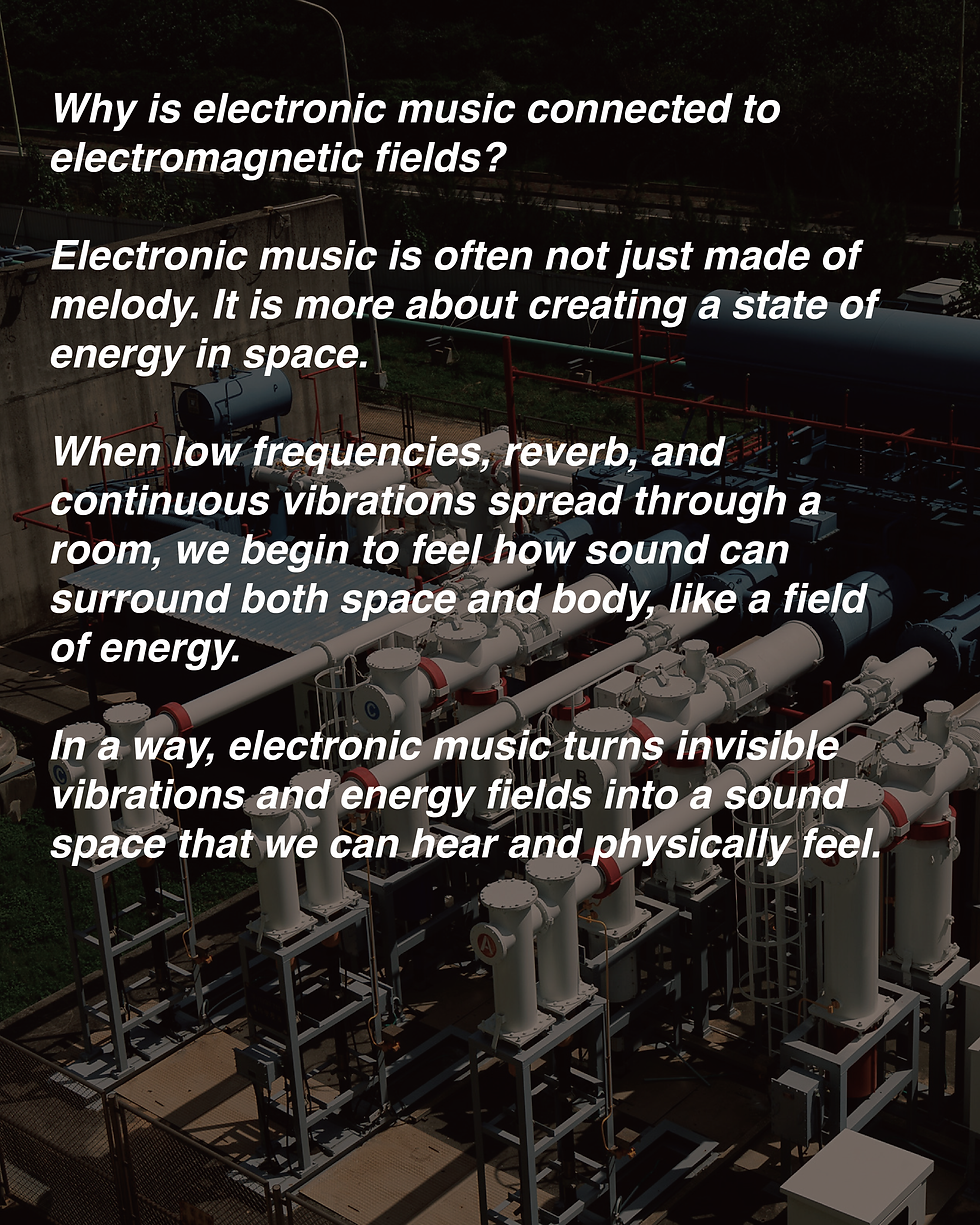
為什麼電子音樂與電磁場有關? 電子音樂很多時候並不是單純由旋律組成,而更像是在創造一種空間中的能量狀態。
當低頻、殘響 與持續震動開始在空間中擴散時,我們也開始感受到聲音如何像能量場一樣包覆空間與身體。
某種程度上,電子音樂其實就是把看不見的振動與能量場,轉化成可以被感受到的聲音空間。

【聲音對照:Electromagnetic Field】 Sa Pa / Ambeesh 電力除了流動的電流之外,同時也形成一種看不見的能量場,稱為「電磁場」。 這些能量在我們所處的空間中擴散,形成一種持續存在但難以察覺的振動環境,有時會因為靜電而突然被電到,那一瞬間,其實就是短暫感受到空間中的電場。Sa Pa 的聲音創作以緩慢流動的聲音場域,低頻與噪音在空間中交織,模擬創作出電磁波在環境中傳遞與共振的能量,某種程度上就像把這些看不見的能量振動放大成可以聽見的聲音。 Beyond the flow of electric current, electricity also generates an invisible energy field known as the electromagnetic field. These energies permeate the space we inhabit, forming a constant yet barely perceptible vibrational environment. Occasionally, a static shock briefly reveals its presence, making the electric field momentarily tangible.
Sa Pa’s sound work unfolds as a slowly evolving sonic field where low frequencies and noise textures interweave. It simulates the transmission and resonance of electromagnetic waves, shaping conditions of propagation and interference. In this way, it renders otherwise invisible energy vibrations audible.
Comments